Michael Mandiberg

Michael Mandiberg header image

Dead Tree Huggers

February 7th, 2010 by admin
Respond

Academic institutions clinging to print media as arbiter of tenure, disregarding electronic forms are… “Dead-Tree-Huggers”

I tweeted this just now, but I feel like it deserves a bit more context. This came out of an email with Adam Hyde (his coinage!) trying to convince him or one of our collaborators in Berlin to find and scan a print version of this article about our collaborative book project. I have found that the committees reviewing my materials for tenure not only frown on all forms of online publication, they also frown on printed copies of electronic versions of documents even if they also appear in print. A scan of the meatspace dead-tree newspaper is viewed as significantly more “legitimate” than a screenshot of the same text from the newspaper’s website. They are Dead-Tree-Huggers.

Tags:   · · · · No Comments.

Advice on Arts focused Academic Job Interviews

February 6th, 2010 by admin
Respond

Every Winter I am asked for advice on the academic job interview process from friends, adjuncts in my department, former students, etc. I have coached a number of them through the process and on to their first jobs. In the process I have put together a list of  advice.

Whenever I am asked, I never remember them all at once. And I seem to be asked more and more, so I am writing them all down here, to refer people to.

I should emphasize, that these are just opinions, not hard facts. Every situation is different. And this is primarily based off of experience in arts focused searches.

Advice on Academic Job Interviews

1. You should ask the department administrator or search chair (whomever your contact person is) for the names of the people who will be interviewing you. This is an ok question. Research their research. It might give you a sense of what they will ask. If you think it is relevant, and doesn’t look too sycophantish, you may refer to their research in the interview process.

2. The whole day of an on campus interview is an interview. Though it may seem purely a formality or informational when you meet the Dean or Provost, that is part of the interview; she may be sizing you up to see how you will do in your tenure process, or just getting a sense of whether you will fit in the school’s culture, or the makeup of that particular department. When you are having lunch with the members of the department it is part of the interview; that is where you prove that you are a nice person, and can have a relaxed and collegial conversation that IS NOT about work — do not talk about work, or yourself at the lunch/dinner. At all. And, when you are walking with the department chair, or search chair from the meeting with the Dean, to lunch with the department, that is part of the interview too. Is the chair silent? Is he chatty? How do you respond to his personality, during those five minutes walking across the campus quad, or walking down hallways. Explicitly or not, this will all be evaluated.

3. Identify what you want the committee to know about you. What are the key points you want to get across. These are your talking points. You should be presenting these points, ideas, feelings, emotions, etc on all levels, from answering questions, to your body language.

4. Don’t necessarily answer their questions directly. Use their questions do deliver your talking points.

5. Expect certain standard questions. Here are a few common questions:

  • Expect a question about your field. “So what is New Media?” or “How do you define Journalism in the blogging age” or “How do you define the difference between art and design”
  • Expect questions about what you do, how you define your practice, what your 5 year research plan is. This is your chance to really go off on your talking points about your work, and what you *have* done, and what you are planning on doing. Prove that you will hit the ground running, and become more and more productive. Prove that getting tenure will NOT be a problem.
  • Describe a conflict with a student or colleague, and how you resolved it. This is a trick question: this is the collegiality question, so DO NOT pick a peer/colleague. Pick a conflict with a student, and choose something that isn’t just about a disagreement over a grade, or a straight up conflict. Choose something that is not confrontational, and required true pedagogical creativity on your part to resolve it. And choose something that resolved REALLY WELL. Some good examples include any instance of working one on one with a student that turned a conflict student into a star student, helping students overcome their phobias, their disabilities, and their prejudices, or other feel good resolutions. DO NOT talk about when students come to you demanding their grades be changed and how you say no, and then go to the chair, etc… Prove you do not create problems, and that you can diffuse problems by yourself in a way that leads to a better classroom.
  • Expect questions about teaching. What is your experience, what you can teach, teaching theory, etc. Again, hit your talking pionts. You may be applying for a job just outside your degree or your experience (a New Media artist applying for a Design job, or a Film maker applying for a video job) so this may be where you subtly or obviously point out that you are totally capable of doing the job.
  • Expect a question about the difference between where you are coming from and their department. This could have many many permutations, but usually it is  about context. A shift from art school to small liberal arts college. From a big public university to small private school. From a non-denominational to a religious focused school. Or vice-versa.

6. Expect to be asked if you have questions for them. Always have at least two questions for them. These questions should show that you have done research on the department and the school. These should be questions you want to know the answers to, but more importantly, they should prove that you know where the important questions are to be asked. This could be a question about their current curriculum, where their students end up (grad school, working in the field, working at the mall), the role or interrelationships of different departments or degrees in the program, etc.

7. Generally, you don’t want to ask about teaching load, responsibilities, research support, etc, in the phone interview. You can ask these questions in the on campus interview, but only in very careful ways. You can ask an open ended question about how the school supports research, and how much of a focus it is. This may or may not lead to a discussion of what kind of annual travel funding, annual research funding, or one-time new-hire research start-up you may or may not get. But don’t push it too much. Most of the time, the department decides they want you, and then you get to fight over the details with a Dean or Provost.

8. Most importantly: it is all about fit. Do you and your research fit with what the department needs are. Can you teach the classes they need taught? Is your research in line with what they feel will benefit the overall research climate of the department. Is your professional profile high enough to be competitive within the institution, especially when it comes to tenure? Is your professional profile too high such that the committee is either threatened by your achievements, or is afraid you will not stay long at their institution? Will you be able to handle the students and their specific demands or requirements they bring to the classroom — this will a very broad range of specific needs that will be different in every case, from a small Community College to an Ivy League University.

9. Aim for a conversational tone in your interview. If you can make it become as if you are just in a faculty meeting where you are discussing curriculum and the future of the department, you have proven that you fit in all of the above ways. Watch for pronouns. If someone switches into the plural “we” and is including you in that, it is a sign. While this is a rare occurrence, in a sense, it should be your hypothetical goal to focus on. Make them feel like you are really part of them already.

10. On the flip side, do not change who you are and what you do just to fit in. You are who you are. Stay true to that. If you turn yourself into someone else, they are going to figure it out. If they don’t figure it out during the interview process (which they probably will), it will become apparent over your next 3 or 5 or 7 years in the department. If you are a Photographer, and you manage to convince the department that you are a Video artist, you are going to end up having to teach courses that probably don’t interest you as much as they should, and more importantly, you are going to be evaluated based off of your Video art… but you are a Photographer, and you don’t really make Video art… See the problem here? Stay true to yourself, and your practice, it will make you happier in the job, and will make the job happier with you.

Tags:   · No Comments.

Pre-order Collaborative Futures now

February 2nd, 2010 by admin
Respond

Pre-Order Collaborative Futures – March 4th release

On March 4th, we will be holding a book launch for the Collaborative Futures Book at Eyebeam. The digital version is available here, and if you are at Transmediale, you can pick up a copy, but it not, this will be your first chance to get your hands on a dead-tree version of the book. Books will be for sale for $15 at the event, but you can pre-order now for $12 and help make the print run possible.

About the book:

Over 5 days in mid January 2010 the Transmediale festival locked 6 writers and 1 programmer in a Berlin hotel room to collaboratively write a book about the future of free collaboration; the authors started with only the title, and ended the week with a book. Transmediale Artistic Director Stephen Kovats will be on hand to join Eyebeam Honorary Resident Mushon Zer-Aviv and myself to talk about the process of writing the book, and some of our discoveries in the collaborative process. Stephen Kovatz will also talk about the ‘Futurity Now’ concept of TM10 in general and particularly in the context of the Collaborative Futures book sprint.

This will be your first chance to get your hands on a dead-tree version of the book. Books will be for sale for $15 at the event, but you can pre-order now for $12 and help make the print run possible. Click here to pre-order!

The “Collaborative Futures” book sprint was facilitated by Adam Hyde (FlossManuals.net) and authored by Mike Linksvayer, Michael Mandiberg, Marta Peirano, Alan Toner, Mushon Zer-Aviv and several additional collaborators using the Booki software (booki.cc) by Aleksandar Erkalovic.

Tags:   · · 8 Comments

This makes me angry

February 1st, 2010 by Michael
Respond

This makes me wish I had a big fat marker with me to cover this up in something other than this insidious shit. And i don’t really ever have the impulse to tag.

Canal and Broadway. All you Chisel-tippers and KRINKers go after it.

eriffs

Tags: Comments Off

From the Archive… Q: Head Scarf?

January 28th, 2010 by Michael
Respond

From October 2008… this post was caught in WordPress limbo. I publish it now, well after this NYC microtrend has gone national, if not global. The questions remain the same, the scope has just increased…

Head Scarf

I’ve noticed a new NYC microtrend of people wearing billowy checkered cotton scarfs around their necks. They remind me distinctly of Yasser Arafat’s Keffiyeh. (http://en.wikipedia.org/wiki/Keffiyeh). Fashion can be pretty fascinating in its ability to absorb and appropriate otherness. So while we are at war with much of the Arab world, and Arab-Americans are feeling threatened and misunderstood enough that they have had to launch an advertising campaign in the subway, NYC consumerist fashionistas have appropriated the Keffiyeh. I wonder whether the wearers know what they are wearing, and whether they see it is some kind of statement, or just “cool.”

Tags: Comments Off

HOWTO CC in Instructable form

January 27th, 2010 by admin
Respond


HOWTO Negotiate a Creative Commons License: Ten StepsMore DIY How To Projects

After a recent conversation with an author that signed a contract and then realized she should have negotiated a Creative Commons license for it, I realized I should revive the HOWTO CC post as an instructable. Same content, new form. New community.

Original all-text-no-pictures version here

Tags:   · · · No Comments.

We wrote the book: “Collaborative Futures” Transmediale booksprint

January 25th, 2010 by admin
Respond

Transmediale FLOSSmanuals booksprint

I’m on the airplane back from the Transmediale FLOSSmanuals booksprint in Berlin. In five days, six core authors, one programmer, and a handful of additional local and remote contributors collaboratively wrote, edited, and published Collaborative Futures, a book on collaboration. We started Monday morning with only two words: the title of the book. As we raised a toast to our success with the festival director Stephen Kovats at 10PM Friday, we sent the book to the printer. It is due back on Wednesday.

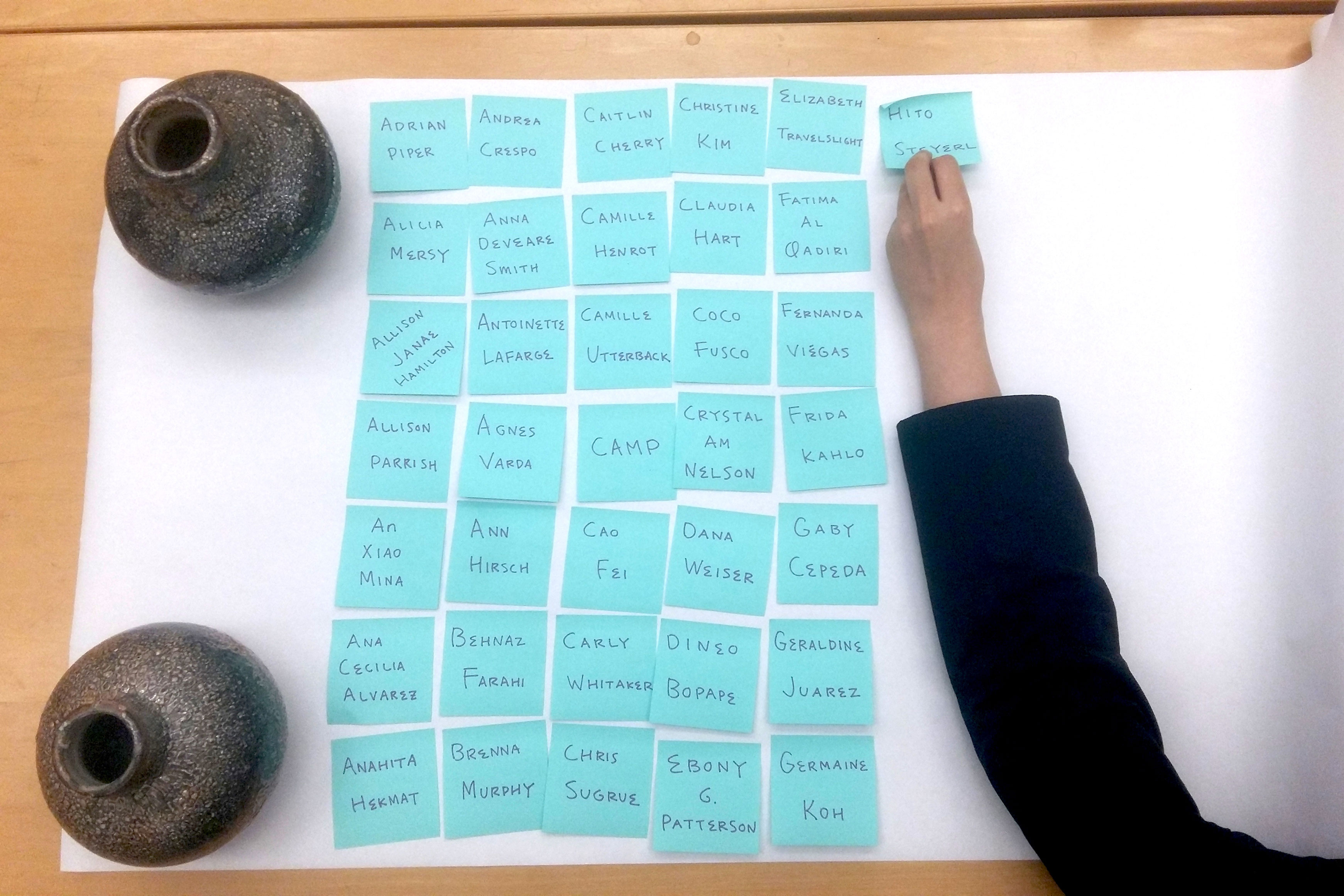
We worked in a large hotel room in a arts compound in Berlin that was a former factory. The first day we just talked about our personal backgrounds, and the ideas and experiences we thought were relevant to the topic. We each knew the organizer, Adam Hyde of FLOSSmanuals, and I knew Mushon Zer-Aviv who is one of my colleages from Eyebeam, but I had never met the remaining participants, Aleksandar Erkalovic, Mike Linksvayer, Alan Toner, and Marta Peirano. We didn’t even know who the other participants were until a few days began the sprint. As we introduced ourselves, our job was to write down all of the topics that came to mind, or were embedded inside of each presentation. We wrote these on post-it notes and put them up on the wall. By the time we broke for dinner there was a rainbow of 100 post it notes arrayed on the wall. We went out for dinner, and returned to arrange the notes on the wall in groupings. By the end of the night we agreed on a very very rough and rather generic outline: Introduction, Definitions, Process, Futures, Epilogue.

As we drank to our success, Stophen asked us if we ever doubted whether we would accomplish our crazy goal. I said that I never doubted, but Adam said that he was really worried when he returned the second morning to 100+ seemingly random notes on the wall, and a truly vague outline. But we started writing, each taking on a topic we were personally invested in. We wrote from 10am to midnight, with a break for dinner. We did this the remaining four days. One day we left to go to the open air Turkish markets near by to get more food for dinner. The Berliners left for the evenings, but the rest of us slept in the compound. Other than that I only left once to see a friend for a drink. We worked hard.

At the outset, Adam stated that he hoped we would write aout 17,000 words, which comes out to about 100 pages. A respectable, but thin volume. The main goal was to finish *something* and that hopefully that something would be cohesive. We ended up writing 33,000 words. We restructured the book several times, moving chapters in and out of sections, renaming, adding, and removing whole sections. We discovered topics that we realized needed to be covered, and we ended up not writing about many of the things we initially thought to be important. I can’t say for sure, as I am still way too close to the initial writing (we only finished 36 hours ago), but I really do think it is cohesive. Despite only working with each other for a total of 5 days, we quickly developed a common language, a strong working methodology that was a version of disciplined anarchy mixed with an immediate trust in each other to peer review and rewrite anything we had written ad hoc.

The book was written by artists who work with technology, and writers who write about technology, so it does take technology as a presumption. The book is very much about Free Software, and Free Culture. But what surprised all of us is that we never really talked about either of these specifically. For example, we almost never talked about licenses. What we did talk a lot about were principles and themes that related to any collaboration regardless of technological involvement or topical focus. We spent most of our time talking about about trust, openness, fairness, attribution, respect, organization, and goals. This was a collaboration that had all of these principles, plus it had great collaborators. It was an incredible success.

Tags:   · · · · · 7 Comments

A CRUMB Interview on Open Source and Collaboration

January 18th, 2010 by admin
Respond

CRUMB interview

As I get ready to take part in the Transmediale/FLOSSmanuals book sprint for the “Collaborative Futures” book, I thought it was relevant to drop this blog post about an older interview about FLOSS and art.

A bit ago Dominic Smith of CRUMB interviewed me about my practice in relationship to Open Source and Free Culture. This interview is going to be included in a forthcoming 10 year anniversary book about CRUMB’s activities. Posting this slipped through the cracks, but you can find it here (along with a snippet below):

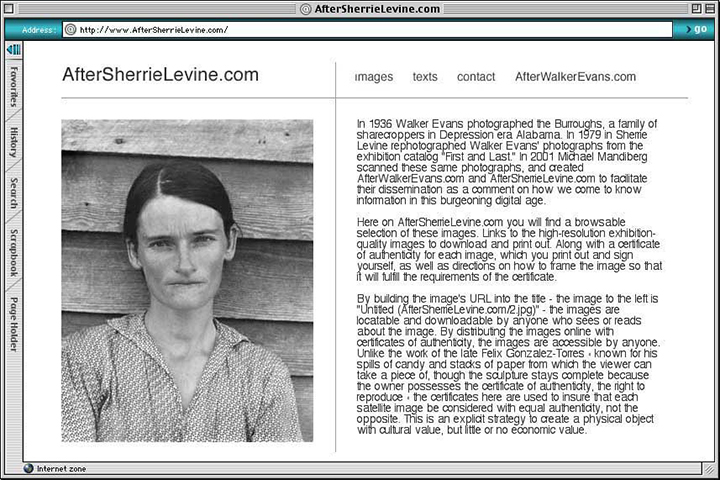
So there is ‘Open Source’ the Noun, and then there are 2 different versions of the verb ‘Open Source’, ‘to Open Source’. So you’re working on a project and you release it Open Source, that’s to Open Source a project. But the other version of to Open Source is a certain kind of reverse engineering, it’s kind of hostile or confrontational, and it’s to Open Source somebody else. I was open sourcing Sherrie Levine in a sense. So I think that a lot of my work comes from that appropriation and that’s a starting point.

Tags:   · · · · · · · · · 1 Comment

Who owns & who controls public space?

January 15th, 2010 by Michael
Respond

Two things happened on my bike today, one which is about advertising and the other isn’t but both are about public space and it’s uses and controls.

One: who owns the street sign posts

This morning I rode my bike to a not-so-close subway stop because I had to run into Manhattan for a meeting and make another meeting in Brooklyn right after that one. And I was late. I get to the station, find a street sign to lock up to, and the guy hawking the Daily News comes up to me yelling. He tells me that is his sign, and that he is going to lock up his newspaper rack AND stool to it, and I have to go find somewhere else. I tell him he doesn’t own the street sign and start locking up, and he says that if I do that he will simply lock his rack up around my bike and I will not be able to get it out. And I’m running late.

As I scuffled off around the corner to find another street sign on the next block my head was full of expletives, but now, sitting on the ferry to Staten Island I am a bit more calm about it, but I have nagging questions: who owns the space. Who has the right to lock what to signs. Are the rights of individuals different than those of corporations. What about corporations acting via pseudo-independent citizens like the Daily News guy. And what is the answer in principle, what is the law’s answer, and how wide is the gap?

Two: obeying the law like an obedient dog.

I ride the Staten Island ferry three times a week to teach at the College of Staten Island. Sometimes I am on bicycle (not as often this semester as I would like) and usually I have a backpack full of books, student papers and my daily rations for my excursion into the crypto-suburbs. Almost every time I pass through the threshold of security I am eyed by the man with the bomb dog. About half of the time he asks me to take my bag off and let his dog inspect it. But every time one of the bomb-dog-men tells me to take off my bag for inspection he says it as if I should already know that I was supposed to take it off for him.

Today I’m running late (its the theme for today) and I am trotting towards the door to the downstairs bikes-only segregated waiting area in my bike shoes (which means I can’t go very fast), and the man yells out “Hey! You!” and points at me. He is jogging over to me. He simply points to the ground. I’ve done this enough times that I have internalized this procedure. I remove my bag and put it on the floor. Take two steps back. You always have to step back from the bag — as if it is a bomb… The dog sniffs it for 10 seconds. Walks back to his master, and the master walks away.

It is amazing that I have been interpolated into the bomb-dog-man’s vocabulary of power. He calls out short commands, I stop, and respond. He points to the ground. I know what the command means, and do as commanded. I am an obedient, well disciplined dog in the dog master’s control society.

Tags: Comments Off

The Best Workshop Description EVAR

January 14th, 2010 by admin
Respond

From Patrick Davison, for a workshop at the Quest To Learn charter school in NYC:

Talking to someone on the internet? Want to seem cool? Want to photoshop their head onto that of a celebrity? Well – the digital savvy know how to do that, but the REALLY digital savvy know that Photoshop’s not the only way. The world of digital image manipulation is too often seen as a one-horse race, but it doesn’t have to be that way. GIMP is the premiere, super-fantastic FREE SOFTWARE tool for photo retouching, digital image creation, and cover-for-the-CD-me-and-my-friends-made-in-my-basement making. Come get an introduction to both at once, learning the strengths and weaknesses of both as you make your Facebook photos look better, and your friends be more jealous of your skillz. With a “z.”

Tags:   · · · · · No Comments.