Tag Archives: Digital Foundations

Digital Foundations Textbook master file on Legal Torrents

I have been trying to find a way to distribute my CC licensed master files, from little Illustrator files, master video files, to the 500MB InDesign file for the Digital Foundations book (http://www.digital-foundations.net). This is an experiment. Because these are all graphics and master files, i am going to put them in “Other.” We’ll see how this goes.

Digital Foundations Textbook master file including all files, links, images

This zip contains all of the inDesign files used to publish Digital Foundations. A description (from the intro) is below. Digital Foundations: Introduction to Media Design with the Adobe Creative Suite integrates the formal principles of the Bauhaus Basic Course into an introduction to digital media production with the Adobe Creative Suite.

via LegalTorrents™ – Digital Foundations Textbook master file including all files, links, images.

Posted in News | Also tagged , , , |

Ping Report: HOWTO CC gets some action

O’Reilly Radar and Boing Boing picked up on the HOWTO CC post, which echoed through the blogs.  Some of of the louder echos are: Robin Good’s reposting, which includes ironic stock photographs (something I’ve been meaning to do!)

Posted in ping report | Also tagged , |

Ping Report

The Postmasters Show on

Alarm
ArtSlant

Bright Bike on:

Trends Update
Rocketboom
DVICE
Gizmodo
Gizmodo.br
Engadget.es
Hilavitkutin
Core 77

Cycleroad
BikeCommuters
Dooby Brain

Digital Foundations on:

blographos
Soulsoup
The Current Buzz

I FFFound out that one of the cover designs ended up on FFFound

Posted in ping report | Also tagged , , |

Ping Report, February 19, 2009

I have a bad habit of not blogging little things. Like when I get blogged. It seems so recursive. But at the same time, I delish them, and then they just stay there.

So in an effort to change that practice, I am instituting a Ping Report, which I will do as needed, but at least once a month. Just links, and maybe some pull quotes from blogs and exhibitions.

To start out, here is a bunch of blog coverage of the Bright Bike, Digital Foundations, and my new laser cut work:

Bright Bike:

Again on MAKE blog
And Reblogged on Rolling Resistance.
And Treehugger
And Daily DIY
And Bike Commuters
And Scooter Scoop
And PSFK
And Style Crave
Trends Update
Bike Hacks
NotCot

Digital Foundations

Was featured on BoingBoing, Creative Commons Blog (twice), and on Just Write Click

Burned Books

James Wagner first post, and second post about his visit to see my new work

The DATA BASE piece was featured on the CRAFT zine

misc…

Here is some coverage of the Bright Idea Shade on Guanabee and Inhabitat

I don’t know if I posted the coverage of 31 Acts on N_P

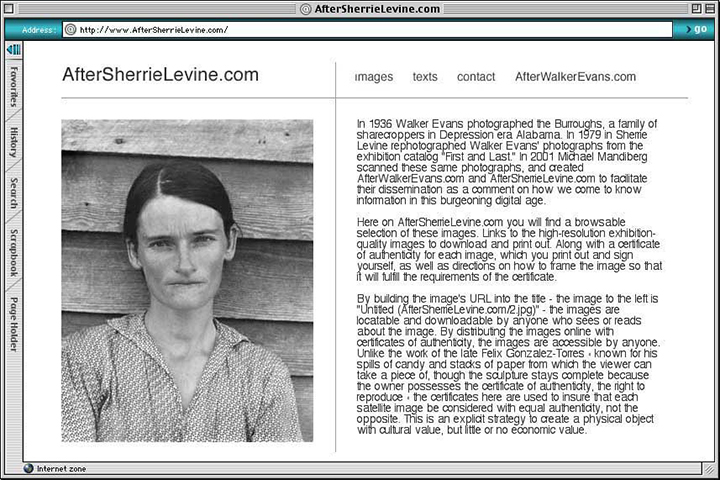
And AfterSherrieLevine.com still riles people up. And was front and center at a conference at Berkeley

Some old news: Oil Standard was in OURS at Parsons

And some really old news: My work was included in http://greenmuseum.org/c/conmob/conmob.html, a show curated for greenmuseum.org by Claude Willey and Ryan Griffis:

curated by Ryan Griffis and Claude Willey with a carload of cultural projects focusing on the problems of mobility and energy. Features works by: Brian Collier, Free Soil, Amy Balkin/Kim Stringfellow/Tim Halbur/Greenaction/Pond, kanarinka, Michael Mandiberg, Laurie Palmer, Platform, Josephine Starrs/Leon Cmielewski.

Posted in ping report | Also tagged , , , |

FLOSSify!


FLOSS Book Sprint: Digital Foundations from Michael Mandiberg on Vimeo.

FLOSSify02

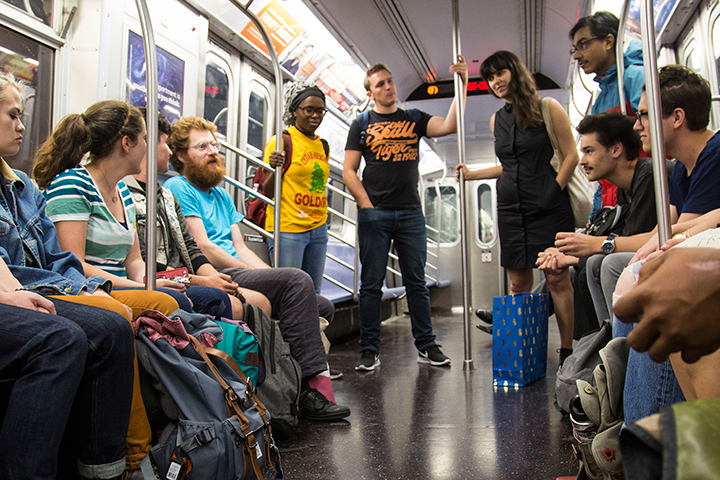
Last weekend was the epic Digital Foundations–>FLOSS Book Sprint, led by Adam Hyde of FLOSSmanuals.net and Eyebeam Senior Fellow Michael Mandiberg. Around 25 volunteers convened at Eyebeam over the course of 3 days to translate Digital Foundations from Adobe to FLOSS (Free Libre Open Sources Software) applications, making good on the promise of Digital Foundations’ Creative Commons license.

Adam Hyde, founder of FLOSSmanuals.net, guided what he has termed the “Book Sprint” where both experts and novices collaborate with the aim of writing an entire book in a fixed period of time. The process was exciting, exhausting, an effective. We are proud to say that the new translation of Digital Foundations and Intro to Media Design with FLOSS is currently available on the FLOSSmanuals.net site, and will be in print shortly. One more step closer to easing the monopolizing power of proprietary software companies.

Posted in Digital Foundations | Also tagged , , , , |

FLOSS Digital Foundations Book Sprint


FLOSS Book Sprint: Digital Foundations from Michael Mandiberg on Vimeo.

Posted in Videos | Also tagged , , , |

FLOSS Digital Foundations Live!

FLOSS Digital Foundations

http://en.flossmanuals.net/DigitalFoundations

For three days in February 2009 Adam Hyde and the members of the FLOSSmanuals.net collective convened at Eyebeam in NYC to translated xtine burrough and Michael Mandiberg’s new Creative Commons textbook Digital Foundations from Adobe software to FLOSS software

Video and print version coming soon

Posted in News | Also tagged |

On Collaboration

I am going through my things tagged “to blog” and this one seems timely. In June of 2008 the CRUMB list was dedicated to a discussion of collaboration. I wrote a long post in response to a post by Steve Lambert, in which he argued that there were multiple forms of collaboration: Master and Apprentice; Collaboration with leadership roles; Totally balanced collaboration (which he admits probably doesn’t ever really exist. He also points out that

The thing is, I don’t think there has to be openness to the outside world. Collaboration ≠ openness. There’s probably people working collaboratively on some weapon at Lockheed Martin or Lawrence Livermore right now that is classified and worked on in secret. The spouses of the engineers have no idea what they do at work. But there are probably great collaborations happening behind closed doors protected by armed checkpoints.

As I get ready for the FLOSSify 1: Digital Foundations event at Eyebeam next weekend, I’m thinking a lot about collaboration, structuring participation, authorship and credit, and team building. So I think it is relevant to revisit some of the things I wrote in my CRUMB post

So here it is, in its entirety, balanced hierarchy for better and faster work:

I am going to talk about a couple of things. One of which is a response to Steve’s post about modes of collaboration. But ultimately the question I think I am answering is “Why Openness?” and also “Why Collaborate?” And my answer is “Faster and Better.”

I am working on a number of projects, almost all of involve working with other people. I work with other people because i have found it is the best way to get the most things done. The best projects happen the fastest when you work with other people. That sounds kind of puerile, but I am quite serious.

The way I work with other people ranges accross the spectrum of working styles Steve has described. I want to point out that the Master and Apprentice, Collaboration with Leadership Roles, and Totally Balanced Collaboration are part of a continuum of collaboration ranging across differing levels of *hierarchy*.

I’m going to go out on a limb here, and say that Hierarchy & Leadership *is* ultimately necessary when people are working together in a significant scale (more than two or three). Even the Park Slope Food Coop, which is my personal paradigm of a successful communal and collaborative organization, has four levels of hierarchy (shift worker, squad leader, coordinator, general coordinator). I see a number of large scale open source projects run out of the OpenLab, and ultimately it comes down to one or two project leaders, who have the vision, the mad skillz, and the enormous time commitment to *organize* the other collaborators. These roles *can* shift over time. This is true for software work and RL work.

I want to describe one of the group-work models I use: I work with two to four student-assistants who are definitely apprenticing under me; they know exactly why they are working with me: they learn TONS and get to contribute to real projects in significant ways. Role-wise I am the creative/technical director who works out ideas with them, and then they are given wide latitude to execute. They return to me with drafts, we discuss, they make revisions. It is often the first time they have been given responsibility for such a large creative project, and they rise to the occasion. Put another way: they have the passwords to all of my FTP accounts. Trust is an important part of collaboration. To suggest that this is a non-hierarchical collaboration would be false, but to suggest that this is not a collaboration would also be false. We are constantly creating things through working together that neither one of us would come up with alone. So Steve, I am going going call it collaboration, and not just b/c I want to feel better about myself esteem (*kisses*)(LOL)

I have also many times attempted to do the perfect-collaboration-where-everyone-has-the-same-responsibility-and-does-the-same-work-and-gets-the-same-credit. _it_doesn’t_work_. someone always flakes out. someone one’s skills are always more labor intensive, or more needed in each project. someone is always too bossy or controlling. nothing is perfect. utopia is the land that does not exist. that is just the way it goes.

One of my favorite instances of a utopian attempt to do this was made by a feminist art collective I knew (and loved) in grad school: when they edited video all three to four of them would sit in the edit lab and edit the video together. sometimes someone on the keyboard, and a different person on the mouse. beautifully poetic utopian attempt to create perfect collaborative balance. two problems: at the time one of them was much better at the software than the others, and ended up doing most of the work (despite the others’ presence at the computer). AND it was phenomenally inefficient: to my knowledge most of their incredible video is still unedited.

Which brings me to my most successful collaboration to date, and also brings me back around to this idea of “openness” and why I work with others to do better work faster. xtine burrough (http://www.missconceptions.net) and I are writing a design textbook called “Digital Foundations: An Intro to Media Design”. It will be published by AIGA Design Press late this Fall, and already up online here (yikes!):http://www.pearsonhighered.com/bookseller/academic/product/0,3110,0321555988,00.html The book integrates the visual principles of the Bauhaus Basic Course into Adobe design software training. In my life as a professor of media art I do a lot of hands on lab based teaching, where I have to teach students how to use the tools so that they can express their ideas. There are no good textbooks to do this with — they are all corporate training manuals without any visual principles or historical perspective, but with a mind-numbing amount of bad design examples (drop shadows and outer-glow anyone?).

So xtine and I decided to write the one *we* and our peers wanted to use.

Here is where openness and the principles of creative commons come to make it happen better and faster. Many of these things are conventional for a open source project, but not for a book or design project:

1. We are using only public domain and creative commons licensed images in our examples. We did a fair amount of research, and realized that our image costs would be larger than the entire budget for our book (http://www.blog.digital-foundations.net/?p=4). So we turned to the public domain and creative commons for our examples: http://flickr.com/photos/digitalfoundations

2. We have secured the first Creative Commons license from Peachpit/Pearson. (CC+, BY-NC-SA) We don’t actually have the contract signed yet (LOL) but we do have the go-ahead. This is huge. Not just as a symbolic marker of the acceptance of ‘openness’ in the proprietary media world, but b/c of what it allows us to do. Remember: Better and Faster

(nb: we did get it in writing, and it is on the “copyright page” of the book)

3. What we can do with CC // Better and Faster: Though the book is only half written(!) we are already planning with Adam Hyde of FLOSS Manuals (http://en.flossmanuals.net/) to translate the book into Open Source. “Translate into Open Source?” you ask…? Yes, translate the core exercises from Photoshop to GIMP, from Illustrator to InkScape, etc. And then, we’ll translate those translations into the growing set of languages that FLOSS Manuals are working in. Imagine: Josef Alber’s color exercises as a means of explaining how to use the color picker in InkScape… in Farsi. This is openness because it is Better and Faster.

4. In fact we have an entire chapter (#2) which talks about Creative Commons, Fair Use, and openness. Find another intro textbook that does that! http://wiki.digital-foundations.net/index.php?title=Chapter_2_Sandbox

5. We have been blogging the writing of the book (http://www.blog.digital-foundations.net/) to share our research and process. Comments become a key component of judging feedback. Expect a post on “How to get a CC license from your publisher” We share our findings, and others have provided immediate feedback.

6. We are writing the book on a WIki (http://wiki.digital-foundations.net/index.php?title=Main_Page) so that we can write collaboratively and incorporate feedback directly. This has already had direct positive results.

So, to recap, for me it is about Better and Faster. Openness is a faster route to better work. There are lots of ways of doing it, but I do think that as much as they pretend pure openness, successful OS projects all have hierarchy.

Faster and Better,

michael

Posted in Thoughts | Also tagged |

FLOSSify 1: Digital Foundations

Digital Foundations In Print

Wanna FLOSS?

We are FLOSSing Digital Foundations next weekend. We need help, and we want to do it *together.* We need people of all levels, from the GIMP guru, to the Ubuntu n00b to test it all.

Digital Foundations uses formal exercises of the Bauhaus to teach design software. It was written for the Adobe Creative Suite, but on Feb 6, 7, 8 we are going to translate it to FLOSS apps with Adam Hyde of FLOSSmanuals.net. For more on the book, and why this translation is so important, see the description below.

We are trying ot get people to register via Facebook

And to sign up on the wiki with their potential role

I hope to see you there. And I hope you can spread the word. By the end of the weekend, we’ll have the first decent primer in FLOSS software!

FULL EXPLANATION:

FLOSSIFY 1 : Digital Foundations

For a long time educational courses have been cheap marketing for proprietary software companies. Can a student really afford all those expensive softwares required by the courses? No. Ever hear of a software company kicking up a fuss because students are using ‘unofficial’ versions? Well, it does happen but not often. And why not? Because proprietary software companies know, as the universities know, that once the students leave their training they will be indoctrinated with those tools and simply slipstream into being paid up proprietary software citizens. Simply put, unlicensed software used in education is tolerated because it is cheap marketing.

This is how tools become ‘industry standards’.

FLOSS Manuals is fighting this flow by converting textbooks that use proprietary software to using free software in their examples.

We call this process “FLOSSify”. We convert the book from closed software to Free Libre Open Source Software (FLOSS) hence we ‘FLOSSify’ the book.

Our first text book is the wonderful Digital Foundations book produced by Michael Mandiberg and xtine burrough (http://digital-foundations.net/). Its a text book designed to teach software by teaching design. The current toolset it uses is the Adobe Creative Suite and we will convert these examples entirely to using free software.

Not only have the authors given the kind permission to go ahead with this, they originated the idea and approached FLOSS Manuals to be involved. We are very happy to get behind this initiative and work with the authors to create a fantastic text book promoting the use of Free and Open Source Software within design courses.

FLOSSIFY 1 : Digital Foundations will focus on a fun 3 day event at Eyebeam, NYC. Anyone is welcome to attend and some food and beer will be provided. Come and meet some of your old geek friends, make some new, and help make a step towards unshackling education from proprietary
software.

FLOSSIFY 1 : Digital Foundations
Eyebeam, NYC
RSVP here http://www.facebook.com/event.php?eid=56609462816
Feb 6-8
starts 10ish
finishes when we are done
fast connection, a table, some chairs, and beer and food provided

http://eyebeam.org/
540 W. 21st Street, (between 10th and 11th Avenues)
New York, NY 10011

Tel. 212.937.6580 Fax: 212.937.6582

Posted in News | Also tagged |

HOWTO CC Translation Project

A few days ago I posted 10 things I learned in the process of successfully negotiating a CC license with a book publisher. This contract was for xtine burrough and my co-authored Digital Foundations, which takes the Bauhaus exercises and translates them into software based exercises. Yesterday Bob Chao posted it on CNET Taiwan fully translated. And then Po-chiang Chao put it up on the Taiwanese CC site.

This got me really excited about a HOWTO CC Translation Project. I have contacted CC’s Fred Benenson who is excited about it too. So, here’s the procedure:

  1. Read the original post
  2. Translate that post into one of the many many CC jurisdictional languages
  3. Post that translation to your blog; if you don’t have a blog, you can email it to me (michael – mandiberg – com)
  4. I will forward those links to Fred at CC, who will make sure they get to the person in charge of that language
  5. I will post links to translations on my blog as they come in
  6. We will make it easier to negotiate for Free Culture

(Thanks Bob Chao and Po-chiang Chao; quite possibly you are the same person? I would thank you privately, but I couldn’t find an email or a contact form, and don’t read Chinese! So your thanks comes publicly.)

Posted in Thoughts | Also tagged , |