Michael Mandiberg's blog
Extinction is Forever
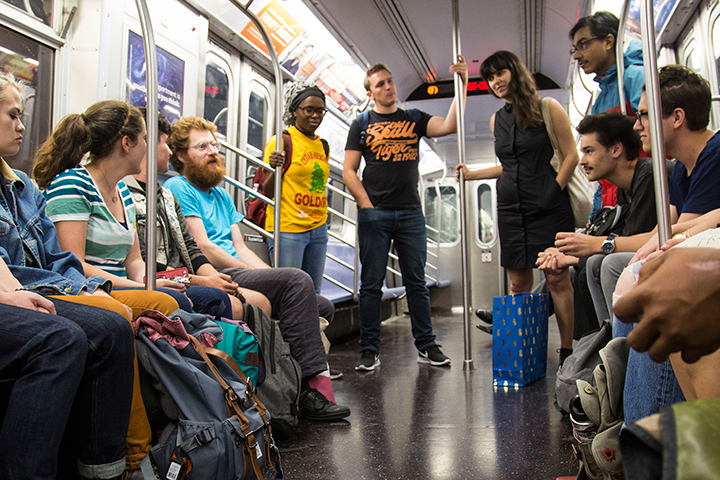
Wed, 02/06/2008 - 18:32 — Michael MandibergIncredible T-Shirt worn by young woman in Union Square NYC. When asked where she bought it, she replied "Urban Outfitters" with a mixed bag of pride at being cool, and shame at knowing that 'Urban' is always a bit too (self-desctructively) ironic, totally unapologetic in the way they rip shit off to make a buck, and ultimately only a few notches above Hot Topic...
Displaced Fake Estates, revisions
Mon, 02/04/2008 - 17:34 — Michael MandibergThe sheet metal I put up 10? days ago has bowed under its own weight. I have added horizontal braces for reinforcements, and an extra vertical brace. It seems to be stiffer, and it seems also to follow a nice parabolic bend (or maybe a catenary?)
The smaller sheet metal had no reinforcement, and got its ass kicked. It was almost like a sail, catching the wind, blowing around, and making a racket. It is much stiffer now, and will hopefully hold up. I moved it from one window to the other, as I realized that the person on the fourth floor is throwing their garbage out the window onto the mirror. I discovered this because peanut shells fell on my head as I was making modifications to it while it was attached to the grate. I looked up to see more peanut shells sailing out of the fourth story window. Brooklyn... I will have to go ask them to not throw their trash out their window. I hope it goes well.
Greener Gadgets: Greenwashing, Green Marketing, and Planned Obsolescence
Mon, 02/04/2008 - 14:31 — Michael MandibergDisplaced Fake Estates, Sheet Metal tests
Wed, 01/23/2008 - 14:59 — Michael MandibergShots of the sheet metal tests of the Displaced Fake Estates. I got a roll of 20" (the widest they stock) sheet metal from Home Depot, and pieced two pieces together with zip-ties. The larger one was reinforced with a 1.5inch by 36inch piece of metal along the length. I need to add reinforcement across the width too, as it bows too much.
The smaller one, without any reinforcement bends and bows like crazy. It looks (and acts) like a sail. But they increase the light!
I did some tests with actual mirrors, which were much heavier, and kind of broke the foam core that the tinfoil was mounted on. The mirrors are reflecting different parts of the building. It looks like I can get away with one foot of mirror that does not see building, but the other two (top and bottom) will show the buildings.
So maybe those two are angled parabolically? This image shows too much parabolic angling. But theoretically, the parabola would work...
Open Source Sustainability Critique on January 26th from 4-6.
Tue, 01/22/2008 - 16:55 — Michael Mandiberg
Eyebeam’s Beyond Light Bulbs programming series is in full swing, with a preview of the upcoming Feedback exhibition on display in our galleries, featuring projects by Sustainability Research Group members Brooke Singer, Michael Mandiberg and Ben Engebreth, alongside those of Eco-Vis Challenge winners. We are displaying the winners and honorable mentions in January at Eyebeam, with a closing Open Source Sustainability Critique on January 26th from 4-6.
We have awarded prizes for the Eco-Vis Design Challenge. The winners are Oz Etzioni, for his Unrecyclable icon (attached below), and The Studio for Urban Projects, for their In Popular Terms, the Evolving Language of Ecology. The winners each were awarded a $2000 prize. You can see images of all of the winning + honorably mentioned works here.
Full on the Eyebeam website.
Great Internet WikiMarathon Invitation
Tue, 01/22/2008 - 00:04 — Michael MandibergHelp write the wikihistory of contemporary art: participate in The Great Internet WikiMarathon
Wikipedia doesn't seem to know much about contemporary art.
So this Saturday, jan 26th 2008, in chat rooms and on coffee tables, the wikimarathon updates Wikipedia with contemporary art.
I, personally, will be at Eyebeam, as I am taking part in the Open Source Sustainability Critique, from 4 – 6PM. So if you are in NYC, you are welcome to join me there.
We (collectively, all of us) have the knowledge. Help put the knowledge into Wikipedia.
We (Joseph DelPesco, Steve Lambert, Marisa Olson, Michael Mandiberg, Bennett Williamson, and Jamie Wilkinson) will be on AIM all day, filling Wikipedia up with good information.
Never posted to a wiki before? No worries: As they say, its easy!
Oh, and, forward forward forward. Amass a force!
Michael
---
<full proper announcement>
http://thegreatinter.net/wikimarathon
Hey all,
Joseph DelPesco, Steve Lambert, Marisa Olson, Michael Mandiberg, Mr. Bennett Williamson, and Prof. Jamie Wilkinson cordially invite you to participate in The Great Internet WikiMarathon. All are welcome. Feel free to pass on the invitation. Here's the details:
http://thegreatinter.net/wikimarathon
There's a lack of art/artist info on Wikipedia, and we're often too busy to find the time to contribute. So, we're setting aside one day where a crew of people collectively drop serious knowledge into wikipedia about art. From your favorite notable artwork, artist or exhibition, to our soon-to-be-famous peers. We'll also add structural links to alumni schools and categories like collective art groups, non profit orgs, etc.
The day is Saturday January 26th: an afternoon on the internet quietly enriching the public domain. We imagine groups of 2-4 people around tables across the country, bottomless coffee cups fueling the discussions, fact checking, and troubleshooting. Ideally lots of "oh, that person worked with X, I'll make a page for them, link me up." There will also be a lot of online chatting across coasts. Video chats if bandwidth permits.
==When==
Roughly 12-8pm EST (9am-5pm PST) Saturday January 26th
==Where==
Wherever you want to gather. At the library (there's books you can reference), at mini house parties, a local art center, or at home.
And of course, on the internet.
* IRC: irc://irc.gimp.org/#artwikimarathon
* AIM: join chat: artwikimarathon
</full proper announcement>
Real Cost update
Mon, 01/21/2008 - 22:57 — Michael MandibergNew version of The Real Costs plugin is available. Version 0.0.7.2 is primarily a bug-fix release. Download it here.
Real Costs is a Firefox plug-in that inserts emissions data into travel related e-commerce websites. The first version adds CO2 emissions information to airfare websites such as Orbitz.com, United.com, Delta.com, etc. Following versions will work with car directions, car rental, and shipping websites. Think of it like the nutritional information labeling on the back of food... except for emissions.
Displaced Fake Estates
Fri, 01/04/2008 - 15:20 — Michael MandibergI did a test run for putting mirrors in my windows to increase the light. Robert Smithson meets Gordon Matta-Clark in window of my first floor Brooklyn apartment. I covered a 24" x 36" piece of foam core with tin foil, and strung it up with plastic frame hanging wire. It doubled the light coming into the window (as measured with a light meter).
Next steps:
- Test if you can/cannot see parts of the building with a small mirror (like a darkroom test strip).
- Make a more sturdy prototype out of metal flashing (this will not reflect the image of the sky, which would be useful under fire-escapes.)
- Consider what to do about the blue cast to the light (It is the blue sky, after all.)
The Emotional Color of Money, Blood, and Water
Fri, 12/28/2007 - 14:53 — Michael Mandiberg
Pantone announced their Color of the Year for 2008: Iris Blue. While their annual choice has oscillated between tints of Red and Blue, Pantone Color of the Year for 2007 was a muted Tan. Of course, in fact the color of 2007 was Green. Green for environmentalism, green for sustainability, green for green marketers, green for money. Are color-ers tired of Green? Not yet. Chevy, today for example, was happy to use Green to sell their cars as a way of turning greenbacks into a green solution.


In his book Dream: Re-Imagining Progressive Politics in an Age of Fantasy Stephen Duncombe argues for a dreampolitik. One of his analyses traces how right wing politicians and corporate advertisers use outlandish but effective associative logics to create meaning built on emotions. He gives a couple key examples: one is a McDonalds ad with a happy family at a park/zoo, which ends with a golden arches logo. He asks why the associative and emotional logic that connects McDonalds to a happy secure and easy family life, could not be associated otherwise: what if instead of a McDonalds logo, there was a sentence about how public space creates leisure and pleasure for families, or how unions help create the financial basis for secure families. But even here (as I rough his argument) I am getting to literal and logical. He wants it associative.
At first glance, it seems not that different from the AdBusters subvertisement model. That re-imagined McDonalds ad could have a happy home at the AdBusters. But there is a difference, I think. Adbusters' model (in one sentence) is to take an existing ad campaign, and ad new ironic content or context that points out the evilness of the brand, or the empty corruptness of consumerism. This has proven to be an effective model for ironic amusement, preaching to the choir (and regular churchgoers), and creating exercises for Digital Imaging classes in art school.
As I understand it, there are two differences in Duncombe's proposal. First, he wants to use the manipulation of associative logic to sell a dream; he is not interested in (reactionary) irony or cleverness. He is looking (it seems) to take on the tool full force to construct an associative narrative. Second, he is talking about its political use, as broadcast on national TV, not shown in a gallery or in a speciality magazine. He is talking about MoveOn.org buying national TV ads (which as I remember them, always seemed smart in a bitter (reactionary) way: not so dreamy).
So where does that leave the artist?
I'm still thinking about this one, and need to think some more before I write it down.
Eco Vis Challenge Winners
Thu, 12/27/2007 - 16:32 — Michael Mandiberg
At a public reception at Eyebeam Saturday, December 15, Executive Director Amanda McDonald Crowley announced the winners of Eyebeam's two-part, online Eco-Vis Challenge competition. Oz Etzioni's Unrecyclable Icon was awarded a $2000 grand prize in the Eco-Icons category, and the Studio for Urba n Projects' In Popular Terms, the Evolving Language of Ecology was awarded a $2000 grand prize in the Eco-Visualization category. The winning projects will be previewed during the month of January, and exhibited as part of Eyebeam's Feedback show in March 2008.
Two proposals in each category received Honorable Mentions and prize money of $150 each, also earmarked for realization of the projects in conjunction with the Feedback exhibition. For Eco-Icons, Green Map was recognized for "creating a comprehensive and inspiring visual system and vocabulary," and Forays' project Edible Excess for "the practical application and smart design of an Eco-Icon." In the Eco-Visualization category, Annina Rüst's RiceCooker was named "a wonderful and novel concept for social conviviality and structured participation," and Timm Kekeritz's Virtual Water and Water Footprints project was recognized for its "clarity, visual literacy and fluency of design.
The competition was juried by engineer and techno-artist Natalie Jeremijenko, mathematician Martin Wattenberg, a researcher at IBM whose work focuses on visual explorations of culturally significant data, Joey Roth, an industrial designer and writer for TreeHugger.com, Casey Caplowe, creative director of GOOD Magazine, Elizabeth Thompson, executive director of the Buckminster Fuller Institute, Eyebeam Research Fellow Michael Mandiberg, and Eyebeam Alumna Brooke Singer, with Eyebeam's Amanda McDonald Crowley and Paul Amitai moderating.
The winning and honored proposals will be on display at Eyebeam in January as a preview for the March 13 - April 19 Feedback exhibition, which will feature the realized proposals alongside work by past and current Eyebeam artists, with others. Both events are part of Eyebeam's ongoing Beyond Light Bulbs programming series, which grew from the conversations and findings of Eyebeam's Sustainability Research Group.
The Eco-Vis challenge was crafted by Research Group members Michael Mandiberg a 2007-08 Fellow in the R&D OpenLab and Brooke Singer, an Eyebeam alum.
The Eyebeam Sustainability Research Group began in July 2006 as a forum for past and present residents, fellows, and staff to engage in a critical dialogue about environmental sustainability. The group's monthly meetings have covered a range of issues, from sharing creative research to working on practical ways to "green" the Eyebeam facility. Out of these meetings, a number of public programs and exhibitions have been developed, including the Eco-Vis Design Challenge, the upcoming Eyebeam exhibition Feedback, and the ambitious 2007-8 program series, Beyond Light Bulbs. Among the Sustainability Research Group reBloggers are: Jennifer Broutin, Carmen Trudell, Brooke Singer, Paul Amitai, Leah Gauthier, Michael Mandiberg and Amanda McDonald Crowley, who have all been contributing content to Eyebeam's reBlog website. This content, as well as the online eco-vis projects of Ben Engebreth, Brooke Singer and Michael Mandiberg will be on display alongside those of Challenge winners.
Prizes were generously underwritten by Deep Green Living, green consultants for home and business.