Tag Archives: collaboration

Collaborative Futures, 2nd Edition

Collaborative Futures, 2nd Editino

The expanded second edition of Collaborative Futures has been completed and is now available for purchase, online reading, and for your contribution. Collaborative Futures is a collaboratively authored book about the theory and practice of collaboration, with a focus on social media and peer-production. The true nature of collaborative culture as a form of creative expression in the context of digital and network technologies has remained elusive, a buzzword often falling prey to corporate and ideological interests.

Collaborative Futures was written by nine core authors over two intensive book sprints. Adam Hyde, Mike Linksvayer, Michael Mandiberg, Marta Peirano, Mushon Zer-Aviv, and Alan Toner wrote the first edition in an experimental five day Book Sprint in January 2010. Developed under the aegis of transmediale.10, this third publication in the festival’s parcours series resulted in the initiation of a new vocabulary on the forms, media and goals of collaborative practice. In June 2010, the book was rewritten as a part of the Re:Group exhibition at Eyebeam, NY. This second edition brought together the original six contributors with three new contributors, kanarinka, Sissu Tarka, and Astra Taylor, to challenge the free culture sentiment underlying the original writing. The result is a deliberately multi-voiced tone pondering the merits and shortcomings of this new emerging ideology.

You can purchase this from Amazon, or you can order a copy directly from me:

Posted in News | Also tagged , , |

Speaking on Panel at Brooklyn College

I am speaking on a CUNY Open Access Week panel on Open Access in the Arts, which includes lecture/presentations by Doug Geers, Nina Paley, and myself. There will be a full screening of Nina Paley’s Sita Sings the Blues to follow panel presentation.

My talk is entitled “Giving Things Away is Hard Work,” and covers my experience creating art & design work with Creative Commons licenses. The talk focuses on the specific strategies I have employed for enabling collaboration when working with non-code based work. If you can’t make it, an earlier (less complete) version of this talk is here.

Wednesday, October 20, 6-9pm @ the Brooklyn College Library, Woody Tanger Auditorium (Directions / Campus Map)

Posted in Talks | Also tagged , , , , , , |

Digital University conference at CUNY Grad Center

I am part of a group of CUNY faculty members, researchers and doctoral students affiliated with the CUNY Graduate Center’s Digital Media Studies Group, that has organized The Digital University, an all-day conference on Wednesday, April 21, 2010, at the CUNY Graduate Center in midtown Manhattan.

Bringing together an invited group of media practitioners, academic publishers, digital content developers and academics, the conference is designed to assess the impact of digital media on academic work and academic policy and authority.

The schedule is here

Participants include:

Cheryl Ball – Illinois State University
Brett Bobley – NEH Office of Digital Humanities
Steve Duncombe – New York University
Kathleen Fitzpatrick – Pomona College
Eileen Gardiner – ACLS Humanities E-Book
Josh Greenberg – New York Public Library
David Greetham – CUNY Graduate Center
Ann Kirschner – Macaulay Honors College, CUNY
Clifford Lynch – Coalition for Networked Information
Ronald G. Musto – ACLS Humanities E-Book
Phil Pochoda – University of Michigan Press
Tom Scheinfeldt – George Mason/CHNM
Trebor Scholz – The New School
Bob Stein – The Institute for the Future of the Book
Siva Vaidyanathan – University of Virginia
John Willinsky – Stanford/Open Journal System

Conference Description

The conference is built around a series of workshops, roundtable discussions and panels, spread across the day, at which conference participants will discuss and debate a broad range of issues related to the main conference themes, including: the impact of digital technology on academic instruction and research; the transformative impact of digital media on traditional forms of publishing, including academic monographs, textbooks, and academic journals; tenure and promotion in an era of digital scholarship; and collaborative research relationships within and across academic institutions and national boundaries. Demonstrations of diverse digital media projects, developed by faculty and doctoral students, will be offered throughout the day.

The conference will culminate in the evening with a public keynote address by cultural historian and media scholar Siva Vaidhyanathan, associate professor of media studies and law at the University of Virginia. Prof. Vaidhyanathan is the author of Copyrights and Copywrongs: The Rise of Intellectual Property and How it Threatens Creativity (2001) and The Anarchist in the Library: How the Clash between Freedom and Control is Hacking the Real World and Crashing the System (2004). We anticipate streaming the conference panels and keynote, both to preserve a record of the proceedings and also to make them accessible to those who are unable to attend in person.

The conference is designed to launch a dialogue about the radical changes made possible by digital media as they fundamentally reshape academic practice at all levels. We hope to explore multiple approaches to these major issues, mixing together academic skeptics and enthusiasts, media visionaries and naysayers, scholars from the global North and the global South, as well as digital and traditional publishers and content developers and providers.

Posted in Talks | Also tagged , , , , |

Collaborative Futures press coverage

Frankfurt Book fair covers Collaborative Futures

The Frankfurt Book Fair covers Collaborative Futures.

Whether this form represents a challenge or indeed a threat to publishing companies is viewed differently. The booksprinters themselves are convinced of it, at any rate. “What we are doing is just one of many forms of writing and distribution that threaten the publishing houses”, according to a confident Michael Mandiberg. Publishing consultant Ehrhardt F. Heinold holds a similar view. He can certainly imagine that the growing self-publishing culture will one day make the classic publishing company superfluous. “In the USA, self-publishing is already a big issue”, as Heinold has observed.

The Japanese magazine Pen covers Collaborative Futures, the IMA Design Village, and Berlin in general

Pen on Collaborative Futures

Posted in Press | Also tagged , , , , , , |

Electrosmog workshop at Eyebeam

My online collaborators Mushon-Zer Aviv and Jonah Bossewitch and I are leading off a day of workshops on online collaboration. I love that Jonah and I will be meeting in person for the first time, and that Mushon will be joining us via Skype. How online-collaborative is that!

ElectroSmog SkillShare: Tools and Models for Online Collaboration

Saturday, March 20, 2010 | 10AM – 5PM

Free with RSVP

Limit of 30 participants (in New York).

This SkillShare was conceived as part of the ElectroSmog Festival, a new, three-day, international festival that will introduce and explore of concept of “Sustainable Immobility”: a critique of current systems of hyper mobility of people and products in travel and transport, and their ecological unsustainability.

10:30AM: Michael Mandiberg, Jonah Bossewitch, and Mushon Zer-Aviv (online) will present current models and challenges of online collaboration:

  • What is and is not collaboration? What are the advantages and disadvantages of different models?
  • Distributed Collaboration as promsing new model of group online development and collaboration
  • Online collaboration methods as a way to bridge cultural as well as geographic distance
  • Discussion of their work together in Berlin on Collaborative Futures

More here

Posted in Talks | Also tagged , , , , |

Collaborative Futures book launch March 4th

Collaborative Futures Cover

March 4th @ 730PM, at EYEBEAM, 540 W 21st St, NYC

Upgrade! NY presents the Collaborative Futures book Launch and talk. Collaborative Futures is a book about free collaboration written collaboratively over five days during the 2010 Transmediale Festival. TM10 locked six writers and one programmer in a Berlin hotel room (pix) to collaboratively write a book about the future of free collaboration; the authors started with only the title, and ended the week with a book. Transmediale artistic director Stephen Kovats will be on hand to join Eybeam senior fellow Michael Mandiberg and Eyebeam honorary resident Mushon Zer-Aviv will discuss the process of writing this book and some of their discoveries throughout the collaborative process. Stephen Kovatz will also talk about the “Futurity Now” concept of Transmediale10 in general and particularly in the context of the Collaborative Futures book sprint.

This event will be your first chance to get your hands on a dead-tree version of Collaborative Futures. Books will be for sale for $15 at the event, but you can pre-order now for $12.

The “Collaborative Futures” book sprint was facilitated by Adam Hyde (FlossManuals.net) and authored by Mike Linksvayer, Michael Mandiberg, Marta Peirano, Alan Toner, Mushon Zer-Aviv and several additional collaborators using the Booki software (booki.cc) by Aleksandar Erkalovic.

RSVP on Facebook

Pre-order here

Posted in News | Also tagged , , , , , , |

CAA Panel – New Media: The Culture of Dispersion

Talk at CAA: New Media: The Culture of Dispersion
Thursday, February 11, 8:00 PM–10:30 PM

CAA 2010

Thursday, February 11, 8:00 PM–10:30 PM

Grand EF, Gold Level, East Tower, Hyatt Regency Chicago
Chair: Patrick Lichty, Columbia College Chicago

Inferences to the Atomization of the Artistic System beyond Institutional Spaces
M. Elena U
beda, School of the Art Institute of Chicago

Art in the Age of Dispersion: Snacks, Niche Culture, and the High End of the Long Tail
Patrick Lichty
, Columbia College Chicago

Giving Things Away Is Hard Work: Three Creative Commons Case Studies on DIY
Michael Mandiberg
, College of Staten Island, City University of New York

Professional Surfers: Contemporary Internet Art and the Montage of Conspicuous Consumption
Marisa Olson
, Rhizome

Using Software (Art) to See the World
Warren Sack
, University of California, Santa Cruz

Posted in Talks | Also tagged , , |

Collaborative Futures in Taz.de

Collaborative Futures in Taz.de

The German newspaper Taz.de has covered our Collaborative Futures booksprint. (English translation here) There has apparently been a lot of buzz about the book during Transmediale. I have received a lot of emails about it, mostly from people who think I am still there and want to pick up copies.

The US release will be March 4th at Eyebeam. Pre-order a copy now.

Posted in Press | Also tagged , , , , , |

Pre-order Collaborative Futures now

Pre-Order Collaborative Futures – March 4th release

On March 4th, we will be holding a book launch for the Collaborative Futures Book at Eyebeam. The digital version is available here, and if you are at Transmediale, you can pick up a copy, but it not, this will be your first chance to get your hands on a dead-tree version of the book. Books will be for sale for $15 at the event, but you can pre-order now for $12 and help make the print run possible.

About the book:

Over 5 days in mid January 2010 the Transmediale festival locked 6 writers and 1 programmer in a Berlin hotel room to collaboratively write a book about the future of free collaboration; the authors started with only the title, and ended the week with a book. Transmediale Artistic Director Stephen Kovats will be on hand to join Eyebeam Honorary Resident Mushon Zer-Aviv and myself to talk about the process of writing the book, and some of our discoveries in the collaborative process. Stephen Kovatz will also talk about the ‘Futurity Now’ concept of TM10 in general and particularly in the context of the Collaborative Futures book sprint.

This will be your first chance to get your hands on a dead-tree version of the book. Books will be for sale for $15 at the event, but you can pre-order now for $12 and help make the print run possible. Click here to pre-order!

The “Collaborative Futures” book sprint was facilitated by Adam Hyde (FlossManuals.net) and authored by Mike Linksvayer, Michael Mandiberg, Marta Peirano, Alan Toner, Mushon Zer-Aviv and several additional collaborators using the Booki software (booki.cc) by Aleksandar Erkalovic.

Posted in News | Also tagged , |

We wrote the book: “Collaborative Futures” Transmediale booksprint

Transmediale FLOSSmanuals booksprint

I’m on the airplane back from the Transmediale FLOSSmanuals booksprint in Berlin. In five days, six core authors, one programmer, and a handful of additional local and remote contributors collaboratively wrote, edited, and published Collaborative Futures, a book on collaboration. We started Monday morning with only two words: the title of the book. As we raised a toast to our success with the festival director Stephen Kovats at 10PM Friday, we sent the book to the printer. It is due back on Wednesday.

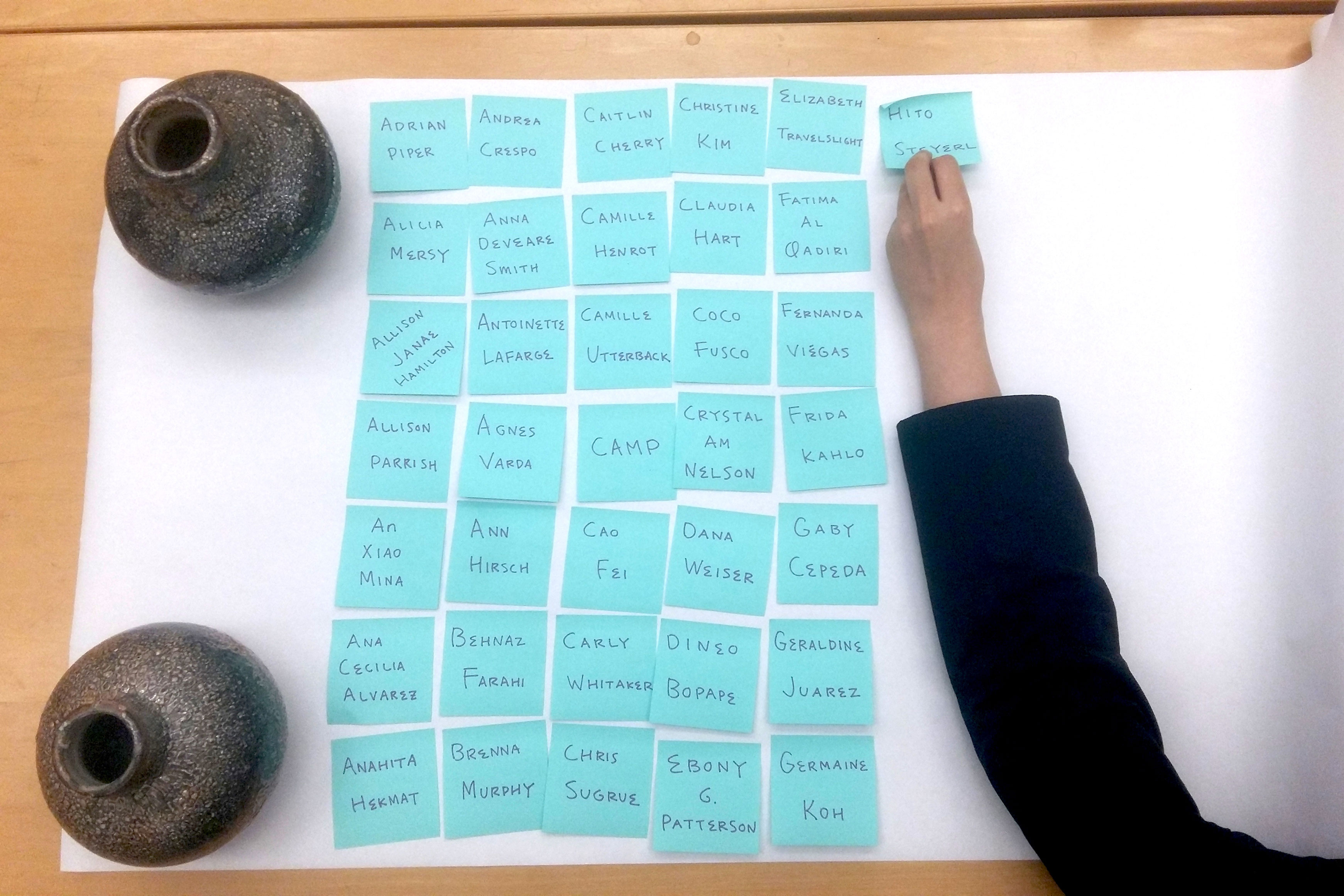
We worked in a large hotel room in a arts compound in Berlin that was a former factory. The first day we just talked about our personal backgrounds, and the ideas and experiences we thought were relevant to the topic. We each knew the organizer, Adam Hyde of FLOSSmanuals, and I knew Mushon Zer-Aviv who is one of my colleages from Eyebeam, but I had never met the remaining participants, Aleksandar Erkalovic, Mike Linksvayer, Alan Toner, and Marta Peirano. We didn’t even know who the other participants were until a few days began the sprint. As we introduced ourselves, our job was to write down all of the topics that came to mind, or were embedded inside of each presentation. We wrote these on post-it notes and put them up on the wall. By the time we broke for dinner there was a rainbow of 100 post it notes arrayed on the wall. We went out for dinner, and returned to arrange the notes on the wall in groupings. By the end of the night we agreed on a very very rough and rather generic outline: Introduction, Definitions, Process, Futures, Epilogue.

As we drank to our success, Stophen asked us if we ever doubted whether we would accomplish our crazy goal. I said that I never doubted, but Adam said that he was really worried when he returned the second morning to 100+ seemingly random notes on the wall, and a truly vague outline. But we started writing, each taking on a topic we were personally invested in. We wrote from 10am to midnight, with a break for dinner. We did this the remaining four days. One day we left to go to the open air Turkish markets near by to get more food for dinner. The Berliners left for the evenings, but the rest of us slept in the compound. Other than that I only left once to see a friend for a drink. We worked hard.

At the outset, Adam stated that he hoped we would write aout 17,000 words, which comes out to about 100 pages. A respectable, but thin volume. The main goal was to finish *something* and that hopefully that something would be cohesive. We ended up writing 33,000 words. We restructured the book several times, moving chapters in and out of sections, renaming, adding, and removing whole sections. We discovered topics that we realized needed to be covered, and we ended up not writing about many of the things we initially thought to be important. I can’t say for sure, as I am still way too close to the initial writing (we only finished 36 hours ago), but I really do think it is cohesive. Despite only working with each other for a total of 5 days, we quickly developed a common language, a strong working methodology that was a version of disciplined anarchy mixed with an immediate trust in each other to peer review and rewrite anything we had written ad hoc.

The book was written by artists who work with technology, and writers who write about technology, so it does take technology as a presumption. The book is very much about Free Software, and Free Culture. But what surprised all of us is that we never really talked about either of these specifically. For example, we almost never talked about licenses. What we did talk a lot about were principles and themes that related to any collaboration regardless of technological involvement or topical focus. We spent most of our time talking about about trust, openness, fairness, attribution, respect, organization, and goals. This was a collaboration that had all of these principles, plus it had great collaborators. It was an incredible success.

Posted in News | Also tagged , , , , |