Tag Archives: CreativeCommons

The Original 1703 Right of Copy

1703 Right of Copy

This is a reproduction of the original 1703 Right of Copy. Queen Anne granted Oxford the right to publish Clarendon’s History for 14 Years.

Yes. 14 Years. Just think of all the work between 1924 and… 1986 that would be part of the Public Domain

via http://blog.mises.org/12151/the-right-of-copy-a-courtly-privilege

Posted in photos | Also tagged , |

CAA Panel – New Media: The Culture of Dispersion

Talk at CAA: New Media: The Culture of Dispersion
Thursday, February 11, 8:00 PM–10:30 PM

CAA 2010

Thursday, February 11, 8:00 PM–10:30 PM

Grand EF, Gold Level, East Tower, Hyatt Regency Chicago
Chair: Patrick Lichty, Columbia College Chicago

Inferences to the Atomization of the Artistic System beyond Institutional Spaces
M. Elena U
beda, School of the Art Institute of Chicago

Art in the Age of Dispersion: Snacks, Niche Culture, and the High End of the Long Tail
Patrick Lichty
, Columbia College Chicago

Giving Things Away Is Hard Work: Three Creative Commons Case Studies on DIY
Michael Mandiberg
, College of Staten Island, City University of New York

Professional Surfers: Contemporary Internet Art and the Montage of Conspicuous Consumption
Marisa Olson
, Rhizome

Using Software (Art) to See the World
Warren Sack
, University of California, Santa Cruz

Posted in Talks | Also tagged , , |

HOWTO CC in Instructable form


HOWTO Negotiate a Creative Commons License: Ten StepsMore DIY How To Projects

After a recent conversation with an author that signed a contract and then realized she should have negotiated a Creative Commons license for it, I realized I should revive the HOWTO CC post as an instructable. Same content, new form. New community.

Original all-text-no-pictures version here

Posted in Uncategorized | Also tagged , , |

A CRUMB Interview on Open Source and Collaboration

CRUMB interview

As I get ready to take part in the Transmediale/FLOSSmanuals book sprint for the “Collaborative Futures” book, I thought it was relevant to drop this blog post about an older interview about FLOSS and art.

A bit ago Dominic Smith of CRUMB interviewed me about my practice in relationship to Open Source and Free Culture. This interview is going to be included in a forthcoming 10 year anniversary book about CRUMB’s activities. Posting this slipped through the cracks, but you can find it here (along with a snippet below):

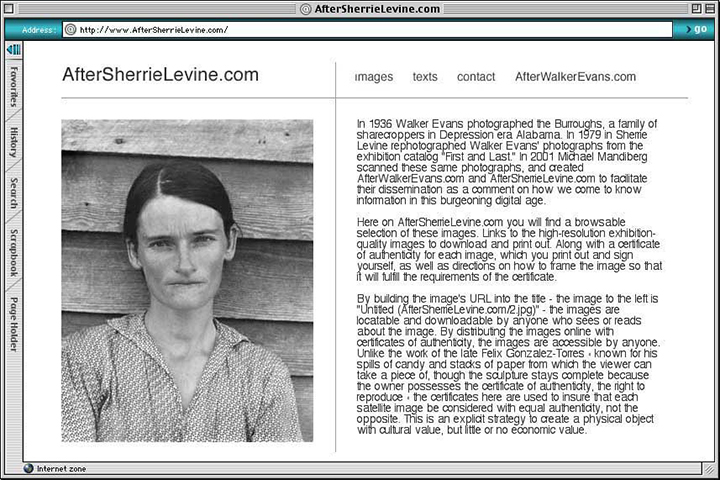
So there is ‘Open Source’ the Noun, and then there are 2 different versions of the verb ‘Open Source’, ‘to Open Source’. So you’re working on a project and you release it Open Source, that’s to Open Source a project. But the other version of to Open Source is a certain kind of reverse engineering, it’s kind of hostile or confrontational, and it’s to Open Source somebody else. I was open sourcing Sherrie Levine in a sense. So I think that a lot of my work comes from that appropriation and that’s a starting point.

Posted in Press | Also tagged , , , , , , , , |

Digital Foundations goes to reprints

Digital Foundations

Celebrate Small Victories: Digital Foundations has run through its initial print run of 8000 copies, and gone into reprints. The publisher has reprinted a run of 4000 copies to meet demand. This semester it was adopted at over 100 colleges and universities; hopefully that number will steadily increase semester by semester. But for now, we celebrate reprints!

Posted in News | Also tagged , , |

Retroreflective Fabric Test

Relfective Fabric Test

This is an update on an ongoing project. I wrote this months ago, but forgot to post it. There will be more posts on new progress soon!

This is a photograph of a test swatch of retroreflective fabric. Alan Paukman and Jacob Melinger of Nikolai Rose helped. But the key producers were Bethane Knudson and the Oriole Mill.

The image doesn’t show it too well, but the threads definitely reflect nicely.

We have had a lot of trouble making it work. Bethane writes about the problems she encountered:

We encountered a number of challenges with using the 3M Scotchlite "yarn". The Scotchlite stretches and breaks when pulled from the spool. Our crew tried various approaches but the breakage continued. We then re-wound the Scotchlite onto a yarn package, called a cone. This allowed for an even release of the Scotchlite which the spool did not. However, having eliminated the problem of the spool, we encountered a new problem –going through the accumulator which feeds the weft to the rapier also stretched and broke the Scotchlite. We slowed the weaving machine down further and that helped but did not eliminate the problem.

While some of the problems in using Scotchlite might be resolved with further investment of time and resources, some cannot. The Scotchlite is not well suited to weaving on the industrial loom. While the Scotchlite has some stretch, it has no recovery — meaning when it stretches, it distorts and does not return to its original state. This would mean that as the garment is worn, the fabric will stretch and would return to its original state, except for the Scotchlite weft. The stretched Scotchlite would ripple, like a seersucker effect, and would eventually break. Scotchlite is too weak to be used as a warp thread and it not really strong enough to be used in the weft for a garment. The demand put on a garment — especially pants — is significant.

The other problem is that a pinstripe is, by definition, a line that runs vertically. Since we used the Scotchlite in the weft, the lines run horizontally. Because garments are cut with the grain of the fabric, the pinstripes will become pin-bands rather than pinstripes. (In some cases the fabric can be used in the horizontal orientation but this limits the length of the pant and alters the drape radically. The warp direction has the best drape.)

Posted in A Partial List of Projects | Also tagged , , , |

Dorkbot PDX talk: FAIL, WIN!, FTW?

I gave a lecture on August 8th at Dorkbot PDX entitled FAIL, WIN!, FTW?. It is a summary of my recent work experimenting with open licensing on physical objects. I explore what has worked, and what hasn’t, and some of the lessons I have learned.

Marisa Olson also spoke; her lecture is here

Posted in Videos | Also tagged , , , , , , , , |

Speaking at Dorkbot PDX, August 9th

Speaking at Dorkbot PDX, August 9th

Marisa Olson and I are speaking at Dorkbot PDX this Sunday, August 7th, 7PM. The annoucement says:

We are extremely honored to have two distinguished artists from New York visiting Portland and sharing their work with DorkbotPDX. Please help us welcome these amazing and inspiring dorks from across the way!

I’m flattered to be called distinguished… !

I’m very grateful to Amber Case for patching us into the PDX scene, and Thomas Lockney and Jason Plumb for setting up this opportunity to share with some PDX dorks.

Sunday, August 7th, 7pm
Location: About Us, 107 SE Washington
http://maps.google.com/maps?q=107+SE+Washington+portland
http://dorkbotpdx.org/dorkbotpdx_0x04

Posted in Talks | Also tagged , , , |

Digital Foundations Textbook master file on Legal Torrents

I have been trying to find a way to distribute my CC licensed master files, from little Illustrator files, master video files, to the 500MB InDesign file for the Digital Foundations book (http://www.digital-foundations.net). This is an experiment. Because these are all graphics and master files, i am going to put them in “Other.” We’ll see how this goes.

Digital Foundations Textbook master file including all files, links, images

This zip contains all of the inDesign files used to publish Digital Foundations. A description (from the intro) is below. Digital Foundations: Introduction to Media Design with the Adobe Creative Suite integrates the formal principles of the Bauhaus Basic Course into an introduction to digital media production with the Adobe Creative Suite.

via LegalTorrents™ – Digital Foundations Textbook master file including all files, links, images.

Posted in News | Also tagged , , , |

Experiments with LegalTorrents.com

I had a long discussion with several of the Research Fellows at Eyebeam about the best way to make master design files available for download. Flickr wont take an AI file, PSDs are just too big, and god forbid you try to upload the master files for your 2 minute video anywhere… We ended up bringing Bre Pettis and Zach Hoeken of Thingiverse.com into the discussion. But concluded that Thingiverse was really focused on 3D modeling, laser cutters, and 3D Printing. They welcomed me to put my Illustrator master files up there, but we all kind of agreed that it was the wrong audience.

Fred Benenson suggested LegalTorrents. After procrastinating, I’ve started the experiment with the Hamilton’s Wood Type catalog #14 book I published on Lulu.com last week.

PDF Download available here via LegalTorrents.

And Master InDesign file available here via LegalTorrents.

I also threw up some Quicktime full res versions of my three most recent videos. I need to clean up the FCP project files, and then I’ll try to upload those too.

It is all an experiment. If you download them, let me know how it goes.

Posted in Thoughts | Also tagged , , |